How to Build a Construction Case Study in the UK
Executive summary: A well-crafted case study turns completed projects into persuasive evidence for your next bid. This guide shows UK contractors how to select the right project, capture key evidence, use photos and video, and highlight outcomes and testimonials. Follow these steps to create case studies that answer procurement questions, showcase your capability, and help you win more work.
Why construction case studies win work
When hiring contractors, buyers in construction and public-sector procurement want proof, not just promises. A good construction case study answers the questions a tender assessor will ask: What was the client’s need? What challenges did you overcome? What exactly did your team do? What measurable results did you achieve? Including the answers in a factual, evidence-based case study builds trust.
Instead of marketing language, use clear project facts. For example, “completed on time and on budget” or “zero safety incidents in 2,400 man-hours” carry more weight than vague claims of “high quality” or “professionalism.” Always aim to demonstrate those claims with data, quotes and visuals.
In the UK, procurement rules and guidance (such as the Procurement Act 2023 and Construction Playbook) emphasise supplier performance and evidence of outcomes. A tender-ready case study aligns perfectly with that by providing documented proof of past performance. It becomes a reusable asset: every PQQ or ITT response can draw on the details, photographs and video your case study gathered.
1. Pick a project that proves what you want to sell
Not every job needs a case study. Start by asking: What work do we want more of? Then choose a completed project that matches those target bids. For example, if you want more hospital refurbishments, use your best healthcare project. If you seek more live-site contracts, pick a job where you worked in an occupied building.
The most effective case studies are relevant, not just the biggest. A £3m hospital fit-out could serve you better than a £10m office block if healthcare is your target sector. Always frame the project by its sector, location and scope so buyers can immediately see the relevance.
2. Gather evidence continuously (don’t wait until handover)
By the time a project ends, many crucial details and photos have vanished. Instead, build your case study throughout the project:
Before work starts: Record project essentials (scope, client needs, value range, timeline). Secure permissions for site visits, photography and interviews. Plan how and when you’ll collect content.
During delivery: Capture progress and process. Take photos of key stages (structural works, special installations, technical details). Have a short interview with the project manager or site foreman at milestone points. Note how you solved problems as they happen.
Project handover: Take final “hero” shots of the completed work. Film or interview the client and your project team about the outcomes. Gather any quantifiable results (e.g. final completion date, cost savings, client satisfaction score).
This timeline shows when to capture content across a project
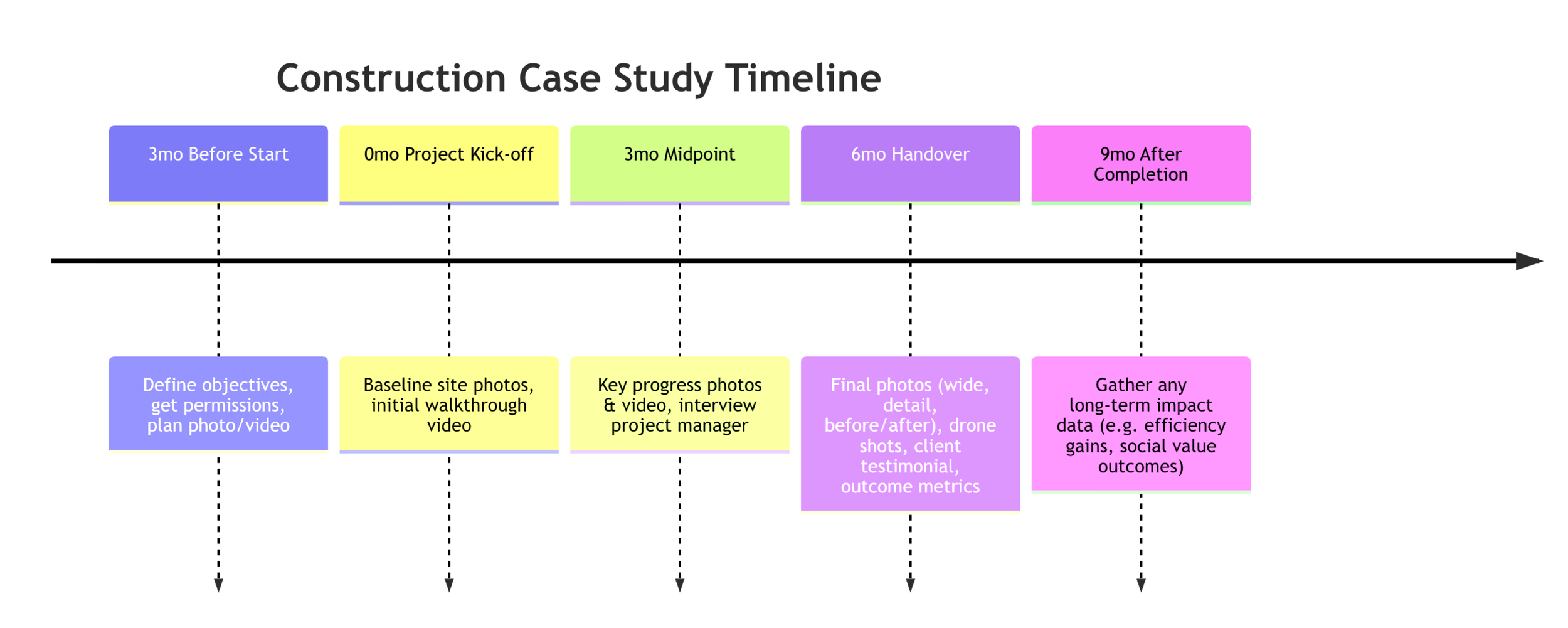
By collecting evidence as you go, you avoid scrambling for memories or permissions later. It also means you capture things that disappear – for example, structural steel inside a finished wall or a critical installation before cover-up.
3. Structure your case study clearly
A tender-ready case study should be organised like a brief project dossier. One useful structure is:
Project overview: Sector, location, contract value range (if allowed), duration and services provided.
Client’s objective: Explain why the project was needed (e.g. expanding a school, upgrading a hospital wing, or fitting out a busy office). What were the key goals?
Challenges & constraints: Detail anything that made the project hard (occupied building, tight programme, limited access, complex M&E, multiple stakeholders, weather, heritage issues, etc.). Be honest – procurement teams expect problems.
Our approach: Describe specific actions and methodology. How did you phase the work? What approvals or surveys did you do? Highlight any innovative or collaborative solutions (e.g. night shifts, prefabrication, stakeholder coordination).
Outcome: State the results. Did you finish early or under budget? Any quality or safety achievements? How happy was the client? Use numbers if you have them: completion date, final cost variance, safety hours, NPS or testimonial snippet.
Visual proof: Include professional photos, diagrams or short videos that illustrate the above. See the next section for media guidance.
Client testimonial: If possible, include a quote from the client or project manager about the experience or results. Third-party praise is hugely persuasive.
Remember, this is not a sales brochure. Write in factual, professional tone – like an engineer or project manager’s voice, not a marketing blurb. Being too promotional will make procurement evaluators sceptical. Instead, focus on clear facts and evidence.
4. Include measurable results and third-party proof
Procurement assessors love numbers. Whenever you can, quantify your outcomes: days saved, budget performance, safety stats, energy savings, BREEAM score, client satisfaction rating, etc. If your contract used KPIs or performance metrics, include them.
Even without formal data, you can note tangible outcomes. For example, “The building was handed over four weeks ahead of the client’s fixed opening date” or “Our site team worked 2,400 man-hours with zero reportable incidents.” These specifics hold weight.
Equally important is the client’s voice. A short quote from the client – ideally with name and role – confirms your claims. Questions to ask your client or project manager for the testimonial could include:
Why did you choose this contractor?
What were you most concerned about at the start?
How did the team meet those challenges?
Would you recommend them (and why)?
A client saying “I wouldn’t hesitate to use this team again” carries far more credibility than any self-appraisal. Make sure to get permission for all quotes and use only genuine feedback.
5. Use photos, video and drone wisely
Visuals are critical to a compelling case study, but each medium has its best use. Here’s a quick comparison:
Content Type Best Use & Benefits
High-Quality Photos
Show the finished project, workmanship and context. Use wide-angle shots for scale, detail photos for craftsmanship, and progress images to illustrate the build sequence. Before/after images highlight transformations.
Video (Site Tours, Interviews)
Convey dynamic information: a site walk-through video can orient the viewer, and interviews allow team members or clients to explain challenges in their own words. Also great for complex processes (e.g. demonstrating how a bespoke element was installed).
Drone & Aerial Footage
Capture site overview, difficult access, and before/after site changes. Drone shots reveal overall scale or multiple buildings that ground photos can’t. They also look impressive in presentations. Use drone video or photos to show the big picture or context.
Tip: Professional photography is ideal, but modern smartphones can suffice for progress shots if lighting is good. However, invest in professional images for your showcase projects whenever possible – the credibility pay-off is significant. Similarly, you don’t need a full film crew for a basic video testimonial; even a quick, well-lit mobile interview can be valuable.
6. Organise and leverage your case study assets
Once you have all the content, present it clearly:
Use headings and bullet lists for readability. Many bid evaluators will quickly scan for keywords, so give them what they need in a structured format.
Include a summary or checklist near the top for quick relevance (e.g. project facts panel or key outcomes). Busy clients often only glance at that section first.
On your website, make sure case studies are easy to find (for example, grouped by sector or service) and not buried. If someone looks for “social value in hospital projects” and you have a case study showing how you delivered social value, make it easily accessible.
Tag or annotate your case study for tender use. Internally, note which tenders this example could support. Your sales team should know: “This case study shows our work in occupied buildings – good for Hospital or Education bids.”
By maintaining a well-organised case study library, your bid team saves time. When a new opportunity comes, they can quickly pull relevant facts, images and quotes from your prepared materials, rather than starting from scratch.
Quick Checklist: Key steps in a tender-ready case study
Choose a project that matches the work you want to win.
Define the client’s goal and context at the outset.
Capture challenges and solutions as they happen (do not wait until after completion).
Take professional photos at each key phase (and consider video/drone for big-picture views).
Include concrete results: timelines, budgets, safety and satisfaction metrics.
Get a client or project team testimonial.
Write in a clear, factual style – avoid jargon and fluff.
Structure the case study by context, challenges, approach, outcome.
Use headings and bullet lists for quick scanning by tender evaluators.
Link the case study to your relevant service or sector pages on the website.
Review confidentiality requirements: use sector descriptions instead of client names if needed, and value ranges instead of exact figures when required.
Frequently Asked Questions
What should a construction case study include?
At a minimum: project overview (sector, location, scope), the client’s need, main challenges, your approach, the results, and any client feedback. Include visuals and any data that proves success.
When is the best time to capture content for a case study?
From the start. Get baseline photos or video at project kick-off. Continue capturing as the job progresses (key milestones, problem-solving moments) and at handover. This ensures you don’t lose important details that disappear behind finished walls.
How long should the case study be?
For a website page or proposal insert, 800–1,500 words is common. The focus should be quality over quantity. Cover all critical points but avoid filler. If something isn’t relevant to a particular tender, your bid team can excerpt the 200–300-word summary needed for that submission.
Do we need professional photographers or videographers?
Professional media yield the best quality and credibility, but quality phone pictures and DIY video can work too, especially for progress updates. Prioritise pro photography for your flagship projects. Good visuals significantly enhance engagement and trust.
Can these case studies be reused for multiple tenders?
Absolutely. The whole point is reuse. Keep an internal record of key project facts, quotes and images. Then tailor extracts for each tender. Well-documented case studies are like a content library: you mix and match sections depending on the bid criteria.
Use your project to win the next one
Your completed projects contain the proof you need to win work. By documenting them carefully as case studies, you turn that proof into a business asset.
If you want a partner to help capture and present your project evidence, we can help. See how SLAMM Works Turn Work Into Proof by combining photography, video and story. When you’re ready to make your next project your strongest proposal, start a project with SLAMM – and turn your work into proof that wins tenders.